



What is the difference between a gold nose ring and a gold nose pin - which is more traditional in India?
What is the difference between a gold nose ring and a gold nose pin - which is more traditional in India?
Last updated: 27 October 2026
The nose ornament is one of the most ancient and culturally layered pieces in Indian jewellery. Unlike earrings or bangles which appear in similarly elaborate forms across many global jewellery traditions, the nose ornament as worn in India carries a depth of regional variation, auspicious significance, and historical continuity that makes it genuinely unique. Yet the two most common terms used for it, nose ring and nose pin are frequently confused, used interchangeably, and misunderstood even by buyers who have been wearing one or the other for years.
The distinction matters. A gold nose ring and a gold nose pin are not simply different words for the same piece; they are structurally different ornaments with different cultural roots, different regional associations, and different practical implications for daily wear. Understanding that distinction clearly is the most useful thing you can do before buying gold nose ring jewelry for yourself or as a gift.
This guide draws that distinction precisely, traces the traditional history of each format across India's regional jewellery traditions, and covers the full range of gold nose ring designs and gold nose stud designs available today from the most traditionally rooted to the most contemporary.
The Core Distinction: Ring vs Pin
At its most basic, the difference between a gold nose ring and a gold nose pin is structural.
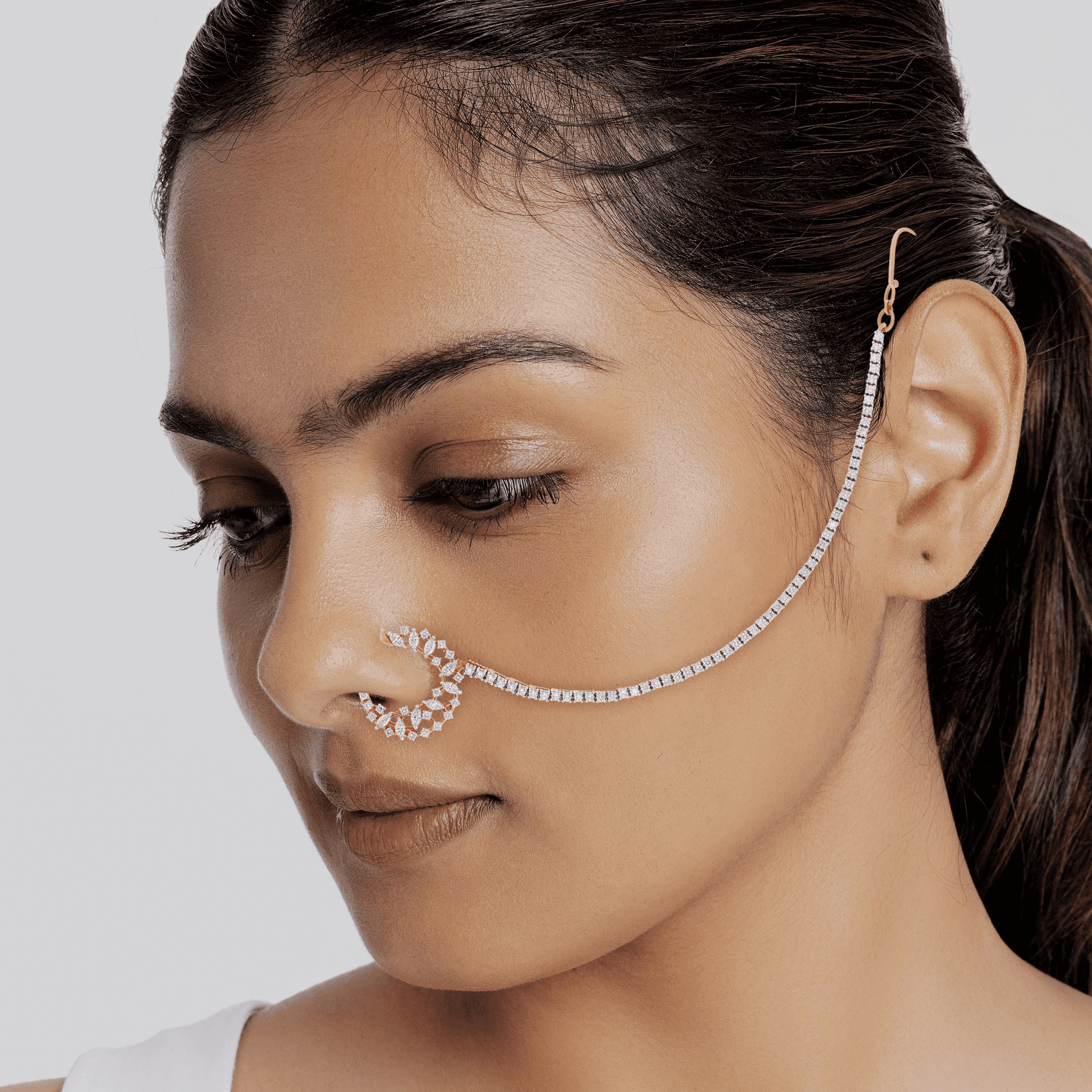
A gold nose ring is a circular or near-circular piece of gold that passes through the nostril piercing and forms a loop either a complete closed circle or an open semi-circle that hooks through the piercing and closes at the back. The defining characteristic is the ring form itself: a continuous or near-continuous curve of gold that is visible as a ring at the nostril. This includes everything from a fine slim hoop that sits close to the nostril to the elaborate traditional nath that extends across the cheek with pearl and stone work.
A gold nose pin also called a nose stud is a decorative element attached to a post that passes straight through the nostril piercing and is secured at the back with a flat disc, a screw fitting, or an L-shaped bend. The decorative element, a gold ball, a flower head, a stone setting, a shaped motif sits on the front face of the nostril, and only this front element is visible. The mechanism is entirely concealed.
In summary: a nose ring is visible as a ring form at the nostril; a nose pin is visible as a single decorative element sitting flush against the nostril. The piercing is the same; the ornament that occupies it is structurally different.
Which Is More Traditional in India?
The honest answer to this question is that both are traditional but in different regional contexts, with different degrees of cultural weight, and with a historical timeline that favours the ring format by a significant margin.
The ring as the older form:
The nose ring is the older of the two forms in Indian jewellery history. References to nose ornaments appear in Sanskrit texts, Vedic literature, and ancient Indian sculptural traditions, and the forms depicted are consistently ring-like circular ornaments at the nostril rather than stud formats. The nose ring's association with marriage, auspiciousness, and the goddess tradition runs through nearly every major regional jewellery tradition in India, from the nath of Maharashtra and Rajasthan to the mukhuthi of South India to the laung of North India.
The nose ring's cultural position in India is also distinct from its trajectory in Western jewellery, where it has a very different and much more recent cultural character. In India, the nose ring is an ancient marital and auspicious ornament; its meaning has never primarily been countercultural or decorative in the way it has been understood in Western contexts.
The pin as a practical evolution:
The nose pin or stud format is a more recent development in Indian jewellery though "more recent" here still means several centuries, not decades. The practical advantages of a stud over a ring for daily wear are evident: it does not interfere with the neckline or clothing as a ring can, it is simpler to secure, it does not shift in position through the day, and it presents only a small decorative element rather than a visible ring form. As daily urban life became more physically demanding and professional contexts began to shape what nose jewellery was practical to wear, the nose pin grew in popularity across most regions of India.
Today, the gold nose pin is the most commonly worn nose ornament for daily use across urban India but it sits in a relationship of clear descent from the ring tradition rather than as a replacement for it. Most Indian women who wear a small nose pin for daily use understand it as a simplified, practical expression of the same ornament tradition that the elaborated nose ring represents in its full form.
Regional Traditions: How the Ring vs Pin Distinction Plays Out Across India
India's regional variation in nose ornament traditions is one of the richest examples of how a single jewellery category can carry genuinely different forms, names, and meanings across a large geography.
Maharashtra:
The Maharashtra nose ring tradition centres on the nath one of the most spectacular nose ornaments in any jewellery tradition in the world. A traditional Maharashtrian nath is a large circular ring, typically set with pearls, rubies, and emeralds on a gold framework, extending to the cheek and hooked into the hair with a supporting chain. The nath is a central element of Maharashtrian bridal jewellery and carries some of the deepest auspicious associations of any bridal ornament in Indian tradition. For daily wear, Maharashtrian women commonly wear a much smaller nose ring, a plain gold ring or a small stone-set ring which is understood as an everyday expression of the same ornament tradition.
Rajasthan:
In Rajasthan, the nose ornament tradition is equally elaborate in its ceremonial forms and equally simplified for daily wear. The Rajasthani borla is a distinctive nose pin format, a round, dome-shaped pendant that hangs from the nostril while the traditional large nath appears in regional variations across different Rajasthani communities. The laung a clove-shaped gold stud is a traditional pin format specific to North and Central Indian traditions, one of the earliest pin-type nose ornaments in the Indian jewellery tradition.
Punjab and North India:
In Punjab and the broader North Indian tradition, both ring and pin formats are worn, with a preference for smaller, finer rings for daily use and more elaborate ring formats for bridal and festive occasions. The gold ring nose piercing format in Punjab often features a small stone-set ring, a ruby or emerald set in a fine gold ring as the primary daily nose ornament, distinct from both the large nath worn for weddings and the minimalist stud that has become common in urban daily wear.
Karnataka, Andhra Pradesh, and Tamil Nadu:
In South Indian traditions particularly in the communities most familiar to customer base across Karnataka, Andhra Pradesh, and Tamil Nadu the nose ornament has a distinct character. The mukhuthi or mookkuthi (the South Indian nose pin) is traditionally a small gold stud often with a fine stone setting or a plain gold ball worn as a daily ornament from the time of the first nose piercing. This gives the stud a more primary and traditionally rooted status in South Indian jewellery than it has in some other regional traditions, where the ring is more clearly the senior form and the stud a simplification.
The South Indian bridal nose ornament typically takes the form of a side nose ring, a small decorative ring at the nostril rather than the large extending nath of North and West Indian traditions. Regional South Indian bridal nose rings are finer, more restrained in scale, and often feature a single stone or a small set of pearls within a gold ring frame.
Bengal:
In Bengali jewellery tradition, the nolok, a small nose ring, is a traditional daily ornament with strong marital associations. Plain gold ring forms, finely made and small in diameter, are the most consistent Bengali nose ornament for both daily and ceremonial wear.
Gold Nose Ring Designs: The Main Formats
Within the gold nose ring category, several distinct design formats serve different wearing contexts.
Simple plain gold ring:
The most enduring and widely worn gold nose ring design is a fine, smooth ring in 22K yellow gold, with a diameter small enough to sit close to the nostril, secured either through a continuous closed form or a small opening that closes at the back. A plain gold ring at the nostril is the daily nose ornament across many South Indian, North Indian, and East Indian communities simultaneously the simplest and the most traditional form. A 22k gold nose ring in plain format is the most purchased nose ring type across showrooms because of its universally appropriate character: it carries traditional weight without requiring traditional dress as its context.
Stone-set gold nose ring:
A gold ring set with a single stone traditionally ruby or emerald, more recently also diamond, occupies the space between the everyday plain ring and the full bridal nath. A ruby-set gold nose ring is a traditional daily ornament in many South Indian communities; a diamond-set gold ring nose piercing is a contemporary choice with equally deep roots in the auspicious stone traditions of Indian jewellery. Stone-set gold nose rings are available with a range of stone types in 22K gold settings, all BIS hallmarked with complete HUID traceability.
Fine contemporary hoop:
A slim contemporary hoop in fine-gauge gold thinner than a traditional ring, with a diameter close to the nostril has become the fastest-growing gold nose ring format among younger buyers in urban India. It sits between the visual character of a traditional ring and the clean contemporary line of a minimal piece, reading as fine gold nose ring jewelry rather than as a marked cultural ornament. This format suits contemporary dressing most naturally but carries no cultural dissonance when worn with traditional outfits.
Traditional nath for bridal and ceremonial occasions:
The nath in its various regional forms remains the most elaborate gold nose ring design in Indian jewellery and the centrepiece of bridal nose ornament tradition. Bridal nath designs are available in 22K gold with pearl and stone work in South Indian regional styles a significant purchase for bridal occasions and the most culturally rooted of all nose ring formats.
How the Gold Nose Pin Price and 1 Gram Gold Nose Ring Price Are Determined
The gold nose pin price and 1 gram gold nose ring price are both determined by the same underlying logic as any gold jewellery purchase: the weight of the piece in grams and the current gold rate at the confirmed purity on the day of purchase. A 1 gram gold nose ring price will reflect one gram of 22K gold at the day's rate, with any stone value as a separate component for set pieces. Always ask for itemised, weight-based pricing at a showroom or confirm pricing transparency when buying online so you understand exactly what you are paying for the gold content of the piece independently of other factors.
What to Check Before Buying a Gold Nose Ring or Gold Nose Pin
Whether you are buying a plain 22k gold nose ring for daily wear, gold nose ring jewelry for a festive occasion, or small nose pin gold for everyday use:
BIS hallmarking and HUID: Every gold nose ornament ring or pin should carry BIS hallmarking with a HUID number confirming the stated gold purity. This is the only independent certification available in India and the non-negotiable baseline for any gold jewellery purchase.
Correct fitting type for your piercing: Nose ring fittings vary open rings that hook through the piercing, hinged rings with a secure back closure, continuous rings, and for studs: straight posts, L-bend posts, and screw-back fittings. The most secure fitting for active daily wear is a screw-back for studs or a hinged-closure ring for ring formats. Confirm the fitting type works for your piercing placement and daily activity level.
Correct sizing: For ring formats, the inner diameter of the ring determines how it sits at the nostril. Too large and the ring hangs rather than sitting close to the nostril; too small and it may be uncomfortable to insert and remove. Confirming the right diameter at a showroom is strongly recommended for ring purchases in particular.
Purity suited to your skin: For women with a history of sensitivity at piercing sites, 14K gold or 18K gold may be more comfortable than 22K, which has a higher alloy metal proportion. For established piercings without sensitivity concerns, 22K is the standard and most culturally appropriate choice for Indian nose ornaments.
Stone certification for stone-set pieces: For gold nose ring jewelry featuring a diamond or significant gemstone, confirm the stone is accompanied by a grading certificate from a recognised laboratory. This is particularly important for diamond-set nose rings and studs where stone quality determines a significant portion of the piece's value.
Why Bhima for Gold Nose Ring and Nose Pin
Since 1925, It has been a trusted name for gold jewellery across South India. From the first showroom on Dickenson Road in Bengaluru to 22 stores today across Karnataka, Andhra Pradesh, and Tamil Nadu, that trust has stayed constant for nearly a century.
Gold nose ring jewelry whether a plain 22k gold nose ring for daily wear, fine contemporary gold nose ring designs in hoop and ring formats, traditional bridal nose ring and nath designs in 22K gold with stone and pearl work, gold nose stud designs in floral and ball formats, small nose pin gold styles for everyday minimalist wear, or diamond and stone-set gold nose ring for women across all occasion levels is crafted in BIS hallmarked gold with complete HUID traceability. Every piece is verified in front of you at any showroom, with the hallmark and HUID confirmed before purchase.
For online orders, every nose ornament purchase arrives in tamper-proof certified packaging with complete hallmarking documentation. Buy-back is available on all BIS hallmarked gold pieces.
Whether you visit any of 22 showrooms to browse gold nose ring designs and nose stud options in person trying different ring diameters and stud proportions against your face before deciding or explore the full nose jewellery collection online, the purity assurance and craftsmanship remain the same across every location.
Related Reading on Bhima
Visit a Bhima Store
Visit any of Bhima's 22 showrooms across Bengaluru, Hubballi, Mangaluru, Udupi, Vijayawada, and the rest of South India to browse gold nose ring designs, gold nose stud designs, and bridal nose ornament collections in person, with BIS hallmark and HUID verification done in front of you. Contact Bhima for queries.
Frequently Asked Questions
1. What is the difference between a gold nose ring and a gold nose pin?
A gold nose ring is a circular or near-circular piece of gold that passes through the nostril piercing and forms a visible ring or loop at the nostril. A gold nose pin also called a nose stud is a decorative element on a straight post that passes through the piercing and is secured at the back, presenting only its front decorative face at the nostril.
2. Which is more traditional in India: a nose ring or a nose pin?
The nose ring is the older and more historically rooted form in Indian jewellery tradition; references to circular nose ornaments appear across Vedic literature, ancient sculpture, and early regional jewellery traditions across India. The nose pin or stud is a practical evolution that developed for daily urban wear and has become the most commonly worn everyday nose ornament in modern India. However, in South Indian traditions particularly in Karnataka, Andhra Pradesh, and Tamil Nadu the stud format (mukhuthi or mookkuthi) has its own deep traditional roots as a primary daily ornament.
3. What is a nath and how does it differ from a standard nose ring?
A nath is an elaborate ceremonial nose ring, a large circular ring, typically set with pearls, rubies, and gold work, that extends beyond the nostril and may be supported by a chain hooked into the hair. Regional nath traditions vary significantly across Maharashtra, Rajasthan, and other states. A standard everyday nose ring is much smaller, finer, and worn close to the nostril without extending outward. The nath is a bridal and ceremonial piece; a standard gold nose ring is a daily ornament.
4. Is a 22K gold nose ring suitable for daily wear?
Yes. A 22k gold nose ring in a simple plain or lightly stone-set format is the most widely worn daily nose ornament across many Indian communities. For active daily wear, a ring with a secure back closure, a hinged ring or a screw-back stud-ring hybrid is more practical than a simple open ring that can shift or be displaced. BIS hallmarking confirms 22K purity independently on every piece.
5. What are the most popular gold nose ring designs for everyday use?
The most popular gold nose ring designs for daily wear are the plain 22K gold ring in a small, fine-gauge format, the stone-set ring with a single ruby or diamond, and the contemporary fine hoop that sits close to the nostril. For nose pin formats, the plain gold ball stud and small floral-motif designs are the most consistently purchased everyday pieces.
6. What is the most secure fitting for a daily wear gold nose ring?
For rings, a hinged or click-in closure provides the most secure daily wear fitting; the ring does not have an open gap that can shift during physical activity. For studs, a screw-back post is the most secure fitting, as it must be actively unscrewed to remove rather than simply pulling free. L-bend post fittings are easier to insert and remove but less secure for very active daily wear.
7. How is the 1 gram gold nose ring price determined?
The 1 gram gold nose ring price is determined by the weight of the piece, in this case one gram and the current gold rate at the confirmed purity (typically 22K) on the day of purchase. For stone-set pieces, the stone value is an additional component separate from the gold weight calculation. Always ask for itemised, weight-based pricing to understand exactly what you are paying for the gold content of the piece.
8. What is a small nose pin gold and what designs are available?
A small nose pin gold refers to a nose stud in a minimal, fine proportion typically a very small decorative element, under 4 to 6 mm in its visible face diameter, on a fine post. Designs available in this format include a small plain gold ball, a tiny floral motif, a small stone in a bezel setting, and a fine geometric shape. Small nose pin gold designs are the most popular daily wear nose ornament format for women who want a nose ornament that works across all clothing and occasion contexts.
9. What purity of gold is best for a nose ring or nose pin?
22K gold is the standard purity for Indian nose ornaments; it provides the richest yellow gold tone and is the purity associated with traditional Indian nose ring and nose stud jewellery. 18K gold is sometimes chosen for nose pins with complex stone settings where added hardness supports the setting better. For women with piercing sensitivity, 14K gold reduces the alloy proportion at the piercing site. Whatever purity is chosen, BIS hallmarking with a HUID number confirms it independently.
10. Can I buy gold nose ring jewelry online from Bhima?
Yes. Bhima's online store offers a range of gold nose ring jewelry including plain 22k gold nose ring designs, stone-set gold nose ring for women, gold nose stud designs in floral and ball formats, and small nose pin gold options for everyday wear. All online orders arrive in tamper-proof certified packaging with BIS hallmarking and HUID documentation for every piece.