



What are the most beautiful gold jhumka designs trending in India right now for both daily and bridal wear?
What are the most beautiful gold jhumka designs trending in India right now for both daily and bridal wear?
Last updated: 27 October 2026
The jhumka is one of the most beloved earring forms in Indian jewellery and also one of the most misunderstood in terms of the range it actually covers. Most people picture the jhumka as a single thing: a dome-shaped gold earring with a hanging bell and some filigree work. That version exists and is beautiful. But the jhumka design tradition in India is far wider than that one image suggests, spanning everything from a small lightweight stud-jhumka worn to a weekday office to an elaborate multi-tiered bridal gold jhumka design that takes up a significant portion of the earlobe and dangles well below the jaw.
What makes the jhumka so enduring across the entire spectrum of Indian dressing from the most casual to the most ceremonial is the shape itself. The dome profile, the hanging bell element, and the way the earring moves with the wearer give the jhumka a warmth and dynamism that flat or static earring forms do not carry. Whether a pair of jhumka ear rings is tiny and plain or broad and stone-set, that fundamental character remains.
This guide covers the full range of gold jhumka designs trending in India right now for daily wear, for festive occasions, and for bridal contexts and explains what distinguishes the best designs from simply good ones.
What Makes a Gold Jhumka Design Beautiful?
Before mapping specific designs, it is worth understanding what actually determines whether a jhumka design succeeds visually because this understanding is what separates a considered purchase from one made purely on first impression.
Proportion between the dome and the bell: The relationship between the size of the upper dome element and the hanging bell beneath it is the most fundamental design decision in a jhumka. A dome that is too large relative to the bell makes the earring look top-heavy and static. A bell that is too prominent relative to the dome makes the earring look unanchored. The best jhumka designs, whether minimal or elaborate, achieve a visual balance between these two elements that makes the whole piece read as a unified form.
The quality of movement: A jhumka that moves well on the earlobe responding naturally to the wearer's movement with a gentle, graceful swing is doing something important that a jhumka with a stiff or poorly balanced construction cannot replicate. The hanging bell element should be free to move independently of the dome, and the overall weight distribution should allow the earring to hang straight and swing evenly.
Surface detail suited to the scale: A large bridal jhumka can support elaborate surface detail stone inlay, filigree work, engraved motifs because it has the physical area to carry that detail cleanly. A small daily wear jhumka that attempts the same density of detail at a reduced scale looks busy and poorly resolved. The best jhumka designs match the complexity of their surface treatment to the scale of the piece.
The post and fitting: A jhumka that fits securely and sits at the right angle on the earlobe not tilting forward or backward is a matter of fitting quality as much as design. Push-back or screw-back fittings on heavier jhumka ear rings are more secure for all-day active wear than butterfly fittings.
Daily Wear Gold Jhumka Designs: What Works Best
The daily wear gold jhumka occupies a specific design space that not every jhumka design can fill. The best daily wear gold jhumka for women balances design character with practical wearability. It has enough detail to feel intentional, not so much that it requires careful styling or becomes uncomfortable through a long active day.
Small button jhumka:
The button jhumka, a small dome sitting directly on the earlobe with a hanging bell element below, the whole piece kept compact and close to the ear, is the most practical daily wear jhumka design available. It presents the full visual character of the jhumka format at a scale that works through a full day of professional and domestic activity without fatigue. A button jhumka in 22K yellow gold with fine surface texture or a simple engraved pattern is among the most consistently purchased gold jhumka for women at Bhima bought equally as a first jhumka, an everyday wear upgrade, and a considered gift.
Stud-jhumka hybrid:
A design that combines a flat stud front, a small disc, a floral element, or a geometric shape with a compact jhumka hanging below the post has become one of the most popular jhumka design gold latest directions for daily wear. The stud front gives the earring a clean, contemporary anchor point; the small jhumka below provides the movement and warmth that make the format recognisably jhumka in character. This hybrid suits professional dressing particularly well; it reads as a refined earring from the front and reveals its fuller character when the wearer turns or moves.
Lightweight filigree jhumka:
A jhumka constructed primarily in fine gold wire work filigree or kaarigari carries a traditional craft character while remaining very light on the earlobe. The visual elaborateness of fine wire work at a modest scale means a filigree jhumka can carry considerable design detail without meaningful weight, which is why lightweight filigree designs are a consistent recommendation for women who want a more elaborate daily wear jhumka without the ear fatigue that heavier traditional pieces can cause.
Smooth dome jhumka with minimal detail:
A jhumka where the dome surface is smooth, high-polish, or very lightly textured with the design character coming from the proportion and movement of the piece rather than from elaborate surface work is the most modern traditional gold jhumka design direction for daily wear. These are the jhumka ear rings most naturally suited to contemporary wardrobe contexts; they read as fine contemporary earrings as much as traditional Indian jewellery, which is precisely their appeal.
Bridal Gold Jhumka Designs: The Centrepiece Earring
The bridal gold jhumka design occupies an entirely different design register from the daily wear piece. For Indian bridal jewellery across most regional traditions, the jhumka is among the most important earring choices; its size, elaborateness, and design character are scaled to the full visual weight of a bridal set rather than to the demands of daily wearability.
Layered multi-tier jhumka:
The most elaborate bridal jhumka format multiple tiers of gold and stone work cascading from the earlobe, with each tier slightly broader or differently detailed from the one above, and the jhumka bell hanging from the lowest tier. Multi-tier bridal jhumka ear rings carry extraordinary visual weight and movement and are the earrings most associated with the classic South Indian bridal look. The best multi-tier designs maintain proportional logic across the tiers; each layer relates meaningfully to the one above and below rather than simply adding material for the sake of size.
Chandbali-jhumka combination:
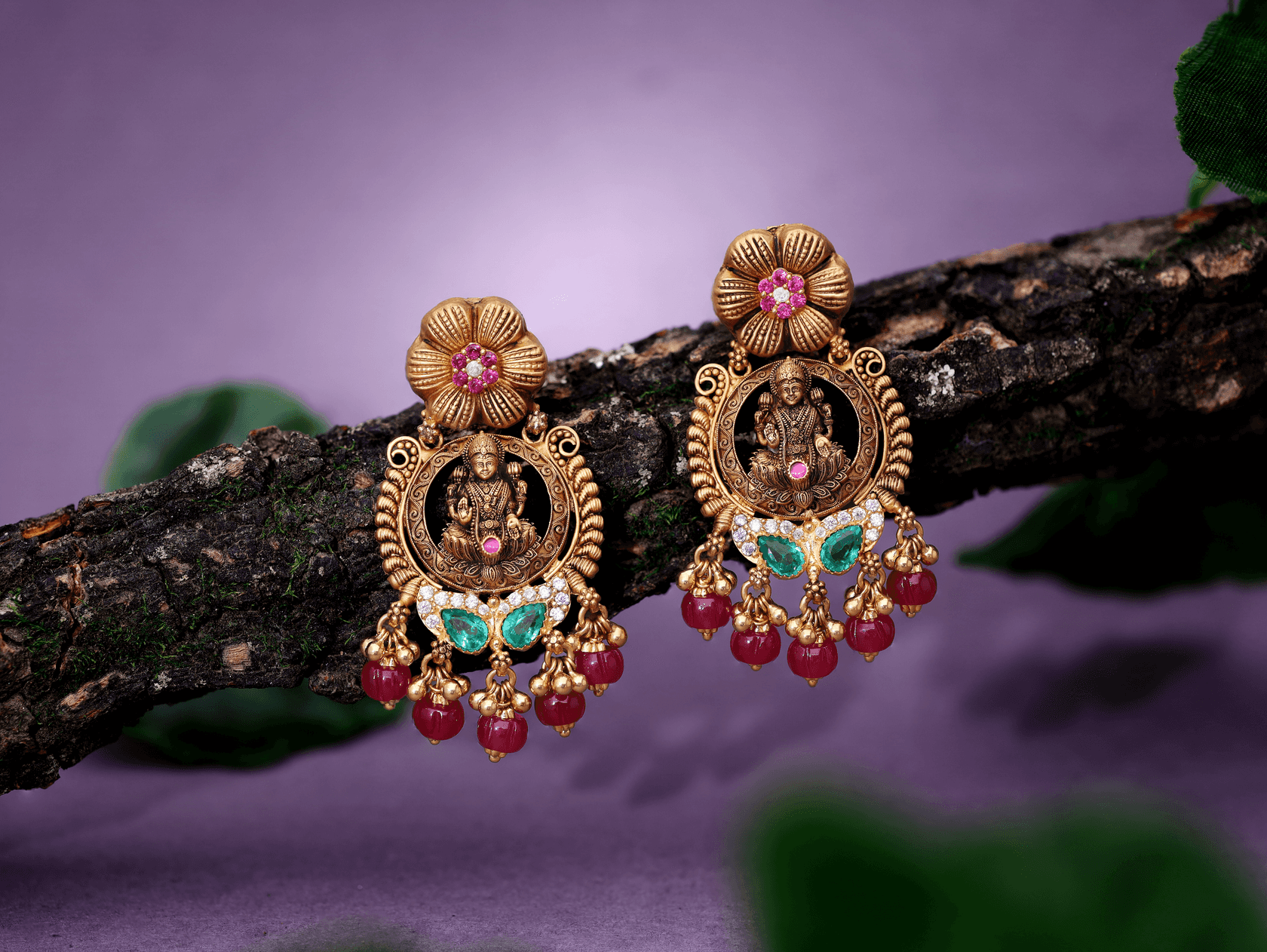
A chandbali, a crescent-moon shaped upper element paired with a jhumka hanging from its lower arc, is one of the most popular bridal gold jhumka design combinations in contemporary Indian bridal jewellery. The chandbali frame lifts the visual centre of gravity of the earring to the cheekbone, while the jhumka below provides movement and the auspicious bell character of the traditional form. Chandbali-jhumka combinations in 22K gold with kundan, polki, or diamond work are among the most requested bridal earring formats at showrooms.
South Indian temple jhumka:
In South Indian bridal tradition particularly across Karnataka, Andhra Pradesh, and Tamil Nadu the temple jhumka is a central bridal earring form. Broad dome surfaces featuring Lakshmi figures, peacock motifs, and temple gopuram-inspired geometric patterns in high-relief 22K goldwork, with a substantial bell and often with ruby or emerald stone accents, characterise this format. Temple jhumka designs are deeply rooted in the devotional and auspicious character of South Indian jewellery and carry a visual authority that more contemporary bridal jhumka designs do not replicate.
Stone-cascade jhumka:
A bridal jhumka where the dome is set with stones in a cascade arrangement beginning with a central significant stone or cluster and graduating outward to smaller accent stones around the perimeter of the dome creates a light-catching effect that has made this format one of the most popular choices for contemporary South Indian brides who want traditional jhumka character with fine jewellery stone work. Stone-cascade jhumka designs in 22K gold with ruby and emerald work have deep roots; versions with diamond and polki are the latest mangalsutra design direction that has grown most rapidly in the last several years.
Jumbo statement jhumka:
For brides who want to make the earring the clearest statement in their bridal jewellery look wearing a broad, heavily detailed jhumka as the counterpoint to a simpler necklace the jumbo statement jhumka in a single-tier but very large format has grown significantly in popularity. These are single-tier pieces but at a scale sometimes falling to or below the jawline that carries as much visual impact as a multi-tier design. The appeal of this format is that its impact is immediate without requiring the visual complexity of multiple cascading elements.
Modern Traditional Gold Jhumka Design: Where Tradition Meets Contemporary
The modern traditional gold jhumka design is perhaps the most creatively active design category in the jhumka market right now. These are designs that take the fundamental jhumka form and reinterpret it through a contemporary design sensibility keeping the dome and bell character that makes the jhumka recognisable while updating the surface treatment, proportions, and detailing in ways that make the piece feel current rather than purely traditional.
The most successful modern traditional gold jhumka designs share a specific quality: they look at home at both a classical Bharatanatyam performance and a contemporary rooftop wedding reception. This versatility is what distinguishes genuinely well-designed modern traditional pieces from those that simply reduce the size of a traditional design without rethinking its character.
The most popular current directions within this category include:
- Geometric dome jhumka: The traditional rounded dome reinterpreted with a geometric faceted surface hexagonal, octagonal, or diamond-faceted panels replacing the smooth rounded form. The structure is unmistakably jhumka; the surface treatment reads as architectural and contemporary.
- Minimal stone-set dome with contemporary fitting: A simple dome in 22K gold set with a single centre stone, a diamond, a ruby cluster, or a single emerald worn with a secure modern post-and-back fitting rather than traditional side hoop. The design is rooted in the jhumka form; the execution is contemporary.
- Abstract motif surface work: Traditional jhumka dome surfaces typically carry lotus, peacock, or deity motifs. Contemporary reinterpretations use abstracted versions of these forms, a stylised lotus outline rather than a detailed depiction, a geometric peacock feather pattern rather than a realistic rendering that carry the traditional vocabulary in a more contemporary visual language.
New Fancy Jhumka Design: What Is Getting Attention Right Now
The new fancy jhumka design category covers the most forward-looking and experimentally designed jhumka ear rings at the higher end of the contemporary Indian jewellery market. These are pieces where the designer's intention is clearly to push the jhumka form somewhere it has not been before in material combination, structural inventiveness, or design character.
Several directions are consistently attracting attention:
- Enamel-accented contemporary jhumka: Bright, saturated enamel work on a gold jhumka dome in deep blue, coral, or emerald green gives the traditional form a graphic vibrancy that makes the earring read as strikingly contemporary while retaining clear Indian craft roots. These are among the most photographed jhumka ear rings on contemporary Indian wedding circuits and have moved steadily from occasion-specific to everyday wear for buyers who dress boldly.
- Floating stone jhumka: A jhumka design where the stones appear to float against the gold surface rather than sitting in conventional settings achieved through tension settings or very fine bezel work that minimises the visible metal holding the stone. The effect is visually sophisticated and carries a fine jewellery character distinct from both traditional and simply contemporary jhumka formats.
- Chain-drop jhumka: A jhumka dome from which multiple fine gold chains hang in place of or alongside the traditional bell element giving the earring movement and a cascading quality while replacing the conventional bell with something more architecturally open. This is a new fancy jhumka design direction that reads very strongly in photography and has grown in popularity for sangeet and cocktail occasion wear.
- Mixed metal jhumka: A jhumka where the dome is in 22K yellow gold and the bell or hanging element is in white gold or a contrasting finish creating a deliberate two-tone effect within a single piece. This direction has grown as yellow-and-white gold combinations have become one of the most consistent trends in Indian fine jewellery design.
What to Check Before Buying a Gold Jhumka
Whether you are buying a small everyday gold jhumka for women or an elaborate bridal gold jhumka design:
BIS hallmarking and HUID: Every gold jhumka should carry BIS hallmarking with a HUID number confirming the stated purity 22K for most jhumka designs in the Indian tradition. This is the only independent purity certification and is non-negotiable for any gold jewellery purchase.
How the earring sits on the earlobe: A jhumka that tilts forward or backward on the earlobe, rather than hanging straight, will look incorrect in photographs and feel uncomfortable through the day. Always try jhumka ear rings on at a showroom before purchasing to confirm how they actually sit on your earlobe.
Weight for the intended occasion: A jhumka that is appropriate for occasional bridal wear can be too heavy for daily use. Confirm that the weight of the piece suits the wearing frequency you are buying it for.
Fitting security: For heavier jhumka designs, push-back or screw-back fittings are more secure than standard butterfly fittings. Check the fitting type and its security before purchasing.
Tamper-proof packaging for online orders: For any jhumka purchased online, confirm it will arrive in tamper-proof certified packaging with hallmarking documentation. all online orders arrive in tamper-proof packaging.
Why Bhima for Gold Jhumka Designs
Since 1925, It has been a trusted name for gold jewellery across South India. From the first showroom on Dickenson Road in Bengaluru to 22 stores today across Karnataka, Andhra Pradesh, and Tamil Nadu, that trust has stayed constant for nearly a century.
Gold jhumka designs whether a small daily wear button jhumka, a modern traditional gold jhumka design in a contemporary minimal format, new fancy jhumka designs for occasion and festive wear, 22k gold jhumka designs in the full range of weights and styles, bridal gold jhumka designs in temple motif and chandbali-jhumka formats, or the jhumka design gold latest directions in geometric and stone-cascade styles are crafted in BIS hallmarked 22K gold with complete HUID traceability. Every piece is verified in front of you at any showroom, with hallmark and HUID confirmed before purchase.
For online orders, every jhumka purchase arrives in tamper-proof certified packaging with complete hallmarking documentation. Buy-back is available on all BIS hallmarked gold pieces.
Whether you visit any of 22 showrooms to try jhumka ear rings on in person, compare how different formats and weights sit on your earlobe before deciding or explore the full gold jhumka collection online, the craftsmanship and purity assurance remain the same across every location.
Related Reading on Bhima
Visit a Bhima Store
Visit any of Bhima's 22 showrooms across Bengaluru, Hubballi, Mangaluru, Udupi, Vijayawada, and the rest of South India to browse gold jhumka designs daily wear, festive, and bridal in person, with HUID verification and hallmark confirmation done in front of you. Contact Bhima for queries.
Frequently Asked Questions
1. What are the most popular gold jhumka designs in India right now?
The most popular current formats span two directions: for daily wear, button jhumkas, stud-jhumka hybrids, and smooth dome contemporary pieces in 22K gold see the strongest consistent demand..
2. What is the difference between a daily wear jhumka and a bridal gold jhumka design?
A daily wear jhumka is designed for all-day comfort smaller in scale, lighter in weight, with a simpler surface treatment and a secure fitting that stays in place through active daily movement.
3. What makes a modern traditional gold jhumka design different from a classic jhumka?
A modern traditional gold jhumka design takes the fundamental dome-and-bell structure of the classic jhumka and reinterprets it through a contemporary design sensibility geometric faceting of the dome surface, abstracted traditional motifs, minimal stone settings, or contemporary fittings while retaining the recognisable jhumka character.
4. What is the right weight for a gold jhumka for women for daily wear?
For comfortable daily wear, a pair of gold jhumka ear rings in the 5 to 10 gram range 2.5 to 5 grams per earring provides enough gold for a well-proportioned design with real visual character while remaining light enough for all-day comfort. Heavier jhumkas above this range are better suited to occasional and bridal wear contexts.
5. What are new fancy jhumka designs and who do they suit?
New fancy jhumka designs are forward-looking jhumka formats that push the traditional form in new directions: enamel-accented domes, floating stone settings, chain-drop elements replacing the traditional bell, and mixed-metal two-tone constructions.
6. What is a chandbali-jhumka and when should I wear it?
A chandbali-jhumka combines a crescent-moon shaped upper element with a jhumka hanging from its lower arc. The chandbali frame lifts the visual centre of the earring to the cheekbone while the jhumka provides movement and traditional warmth below.
7. What is a temple jhumka and what occasions suit it?
A temple jhumka is a gold jhumka design featuring deity figures, Lakshmi forms, peacock motifs, and traditional South Indian temple architecture-inspired geometric patterns in high-relief goldwork on the dome surface. Temple jhumkas are deeply rooted in South Indian auspicious and devotional jewellery traditions and are most appropriate for bridal occasions, temple ceremonies, and major festivals where the traditional character of the design is fully contextually appropriate.
8. How should I choose a gold jhumka design for my face shape?
Oval faces suit the widest range of jhumka designs. Round faces look best with elongated jhumka designs with a longer dome-to-bell proportion rather than very wide dome formats. Square faces are softened by rounder dome jhumkas with softer edge treatment. Long faces benefit from wider dome formats that add width at ear level.
9. Can I buy gold jhumka designs online from Bhima?
Yes. The online store offers a wide range of gold jhumka designs from small daily wear button jhumkas and stud-jhumka hybrids to bridal gold jhumka designs in temple and chandbali formats and jhumka design gold latest directions in contemporary styles. All online orders arrive in tamper-proof certified packaging with BIS hallmarking and HUID documentation for every piece.
10. Does Bhima offer buy-back on gold jhumka designs?
Yes. Bhima offers buy-back on all BIS hallmarked gold pieces, including gold jhumka designs across all formats, weights, and styles. Confirming buy-back terms before purchasing is always a sensible step particularly for a significant gold jewellery purchase like a bridal or high-occasion jhumka design.