



Is a thick silver kada or a thin stacked look better for women with small wrists?
Is a thick silver kada or a thin stacked look better for women with small wrists?
Last updated: 27 October 2026
The silver kada is one of the most versatile and satisfying wrist ornaments in Indian jewellery; it carries cultural weight, works across traditional and contemporary dressing, and suits daily wear as naturally as it suits festive occasions. But the question of which kada format works best on a small wrist is one that comes up consistently and it deserves a more considered answer than the instinctive response most people give.
The instinctive response is usually "keep it thin and minimal on a small wrist." That is not wrong, but it is not the complete picture either. A single thick silver kada on a fine wrist, worn correctly, can look extraordinarily intentional and proportionate. A stacked thin look, equally, can overwhelm a small wrist just as easily as it can flatter it depending on how many pieces are combined and how they are scaled. The answer is less about thick versus thin as a rule, and more about understanding what specific formats, widths, and proportions actually work for small wrists.
This guide gives you an understanding covering the main silver kada formats, how to think about proportion and wrist size, which styles suit different occasions and dressing contexts, and what to check before buying.
What Is a Silver Kada and Why Does Format Matter?
A silver kada is a rigid, closed-loop cuff worn on the wrist broader and more substantial in profile than a standard bangle, but distinct from a flexible bracelet in that it holds its shape independently. The kada sits on the wrist rather than moving freely around it the way a bangle does, which means its width, inner diameter, and the relationship between those two dimensions determines how it reads on the arm.
A chandi kada for women differs from a gold kada primarily in its aesthetic register. Silver's cooler tone carries a lighter, more contemporary character than gold, which suits both traditional kurta dressing and casual contemporary outfits with equal ease. The structural logic, however, is the same: a kada's width, gauge, inner diameter, and surface treatment together determine whether it reads as powerful and intentional or as too heavy for the wrist it sits on.
For women with small wrists, these structural relationships matter more than for women with average or larger wrists because proportional mismatches are more visible and more impactful at a smaller scale.
Understanding Wrist Proportions: The Real Framework
Before arriving at thick versus thin, it helps to understand what actually governs how a kada reads on a small wrist. Three dimensions matter:
- Width (the distance from one edge to the other across the flat face of the kada): This is the most visible dimension that you see when looking at the wrist from above. Width creates visual presence. Too much width on a small wrist and the kada dominates the arm rather than complementing it. Too little width and the piece looks lost.
- Gauge (the thickness of the metal from front to back): A higher gauge means a more substantial feel in the hand and on the wrist the kada feels solid and has clear physical weight. A lower gauge gives a lighter, more delicate feel. For small wrists, gauge matters because a very thick gauge in combination with significant width can make a piece feel heavy in a way that reads physically as well as visually.
- Inner diameter: This determines how the kada sits on the wrist. A kada whose inner diameter is very close to the wrist measurement will sit snugly and move very little; this actually reads better on a small wrist than a kada that slides freely, because a sliding kada constantly shifts to the widest point of the hand and sits unevenly. When buying a silver kada, confirming the inner diameter at a showroom is more important for small-wristed buyers than for average or large wrists.
Understanding these three dimensions rather than simply defaulting to "thick or thin" gives you the framework to make a genuinely good purchasing decision.
The Case for a Single Thick Silver Kada on a Small Wrist
The argument against a thick silver kada on a small wrist rests on the assumption that a large piece overpowers a fine wrist. In practice, this is only true when the kada is also very wide. A kada that is thick in gauge but moderate in width sitting between 10 mm and 18 mm can look strikingly good on a small wrist because of a specific visual dynamic: the single strong piece makes the wrist look more defined and deliberate rather than smaller.
The key is wearing it as the only piece on that wrist. A single thick 925 sterling silver kada for women, worn alone on the wrist without additional bangles or bracelets, creates a clean, confident look that works precisely because it does not try to fill the wrist with multiple elements. The piece and the bare skin around it work together. The contrast between the substantial silver and the fine wrist becomes part of the visual effect rather than a problem to be solved.
Where this works best:
Contemporary and casual dressing a white shirt, a plain kurta, jeans where the single bold piece reads as intentional.
Festive occasions where a bridal silver kada for women is the deliberate centrepiece of the wrist look rather than one component in a layered set.
When the rest of the hand and arm is bare, no rings, no watch, no additional bracelets.
Where it works less well:
When the kada is both very thick in gauge AND very wide (above 20 mm on a small wrist). This combination can overwhelm rather than define.
When worn alongside multiple other wrist pieces a thick kada combined with a watch and two bangles on a small wrist creates too much visual density.
The Case for a Thin Stacked Look on a Small Wrist
The stacked look of two, three, or four slim ladies kada bangles and thin silver bangles worn together has a different visual logic from the single thick piece. Stacking creates a sense of movement and layering that flatters most wrist types, but it requires more careful calibration on small wrists than people typically anticipate.
The risk of stacking on a small wrist is not that the pieces are too prominent, it is that too many pieces at similar widths create a visual block that makes the wrist appear shorter and the stack appear to shrink the wrist rather than extend it. This is the stacked look that does not work.
The stacked look that does work on small wrists follows three principles:
- Graduated widths rather than uniform widths: A stack where one slightly wider piece anchors the set, flanked by two slimmer pieces, creates visual rhythm and hierarchy that reads as deliberate and well-styled. Three pieces of identical width simply multiply without adding interest.
- Odd numbers: Three pieces stack more dynamically than two or four. Three slim silver bangles or two slim bangles flanking one slightly broader silver kada design for women creates a look with more visual energy than even-numbered combinations.
- Spacing and restraint: A small wrist can support a stacked look of two to three pieces comfortably. Beyond three pieces of any significant width, the stack begins to cover too much of the wrist and the pieces start to compete rather than complement. The most common mistake with stacking on small wrists is adding one more piece than the proportions support.
Where the stacked look works best on small wrists:
With traditional ethnic dressing a saree, a salwar kameez, a lehenga where the layered look has clear cultural resonance and the outfit provides enough visual context for a more detailed wrist look.
When the pieces are genuinely fine and slim below 8 mm in individual width.
When mixed with plain thin bangles that provide spacing between more detailed pieces.
Silver Kada Designs for Women: The Main Formats
Plain polished silver kada:
The most enduring silver kada design for women is a smooth, polished round or square-profile band in 925 sterling silver with no surface ornamentation. Plain polished kada carry a clean, contemporary character and suit every outfit type with equal ease. For small wrists, a plain polished kada in a moderate width (10–14 mm) and a medium gauge is the most universally flattering single-piece option.
Engraved and textured silver kada:
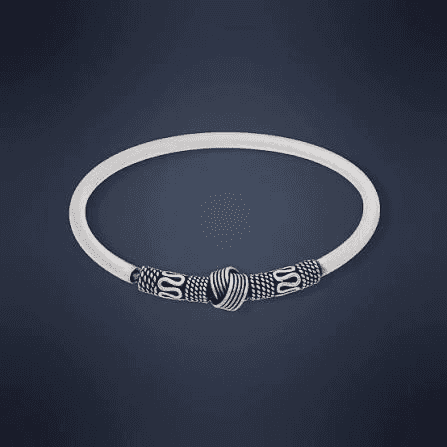
Engraved floral borders, rope-twist patterns, geometric designs, and traditional motifs on a 925 sterling silver kada add visual interest without adding physical width. An engraved bangle silver kada for women reads as more detailed and festive than a plain piece while maintaining the same dimensional profile which makes it a strong choice for women who want a single piece that works across both daily and festive contexts. Surface engraving catches light and creates visual movement that makes a moderate-width piece appear more substantial on the wrist.
Oxidised silver kada:
Oxidised silver kada where the silver surface is darkened through a chemical process that creates contrast between raised and recessed areas of the design carry a distinctive bohemian, traditional, and contemporary character simultaneously. Oxidised silver is a popular finish for chandi kada for women who prefer a less polished, more textured aesthetic. The contrast between dark recesses and bright raised areas makes the design read clearly even in lower light, which gives an oxidised kada a presence that a plain polished piece of the same dimensions does not have.
Stone-inlaid silver kada:
A silver kada set with semi-precious stones turquoise, amethyst, blue topaz, carnelian in bezel settings along the outer face is a popular festive and contemporary format. Stone-inlaid ladies kada bangles sit firmly in the occasion category rather than daily wear. The stone settings require more care in daily use but as a festive or evening piece, a stone-inlaid silver kada is one of the most visually striking options available.
Bridal silver kada for women:
In many Indian regional traditions, silver kada form part of bridal jewellery particularly for South Indian bridal sets where broad silver kada are worn on the wrists and ankles as part of the complete bridal ensemble. Bridal silver kada for women are heavier, broader, and more elaborately ornamented than everyday pieces with high-relief temple motifs, Lakshmi figures, and traditional border patterns. These are occasion-specific pieces rather than daily wear items and are typically worn as a pair or in sets of multiple kada across both wrists.
Leg Kada and Silver Anklet Kada for Women
No guide to silver kada for women would be complete without addressing the leg formats among the most traditional and most consistently purchased silver kada in India.
Leg kada for women
A leg kada worn at the ankle or just above it is one of the most traditional silver ornaments in Indian jewellery, with deep roots in South Indian, North Indian, and tribal jewellery traditions. For women with small wrists, the wrist-proportion question that dominates bangle and kada buying does not apply to leg kada ankle proportions following their own aesthetic logic, and a substantial leg kada on a fine ankle is a traditional and widely flattering combination. Leg kada for women are available in 925 sterling silver in plain, engraved, and traditionally worked formats.
Silver anklet kada for women
The silver anklet kada sits at the ankle in a format that is broader and more rigid than a standard chain anklet but slightly finer than a full leg kada. The silver anklet kada for women is one of the most popular everyday silver ornament categories worn continuously as a daily piece, particularly across South India. For daily wear, a plain or lightly engraved silver anklet kada in a moderate weight is the most practical format for a smooth inner surface for all-day comfort, secure closure, and enough substance to maintain its round profile with daily wear.
For the same proportional logic that applies to wrist kada: on a fine ankle, a single moderately substantial anklet kada reads better than multiple very slim pieces that collectively add up to the same visual weight with less clarity.
Thick vs Thin Stacked: A Direct Comparison
Factor | Single Thick Silver Kada | Thin Stacked Look |
Proportion on small wrists | Works well when worn alone, moderate width (10–18 mm) | Works when pieces are genuinely slim and set at 2–3 pieces maximum |
Outfit context | Contemporary casual, minimal dressing, festive as a statement | Traditional dressing, layered ethnic looks, relaxed casual |
Daily comfort | Very comfortable once fitted correctly sits still on the wrist | Can shift and move more; multiple pieces may feel busy through a long active day |
Maintenance | Simple one piece to clean and store | Multiple pieces require individual care; more opportunity for tangling |
Styling effort | Low one piece makes the decision | Higher requires considered selection of which pieces to stack |
Visual effect on small wrist | Defines and frames the wrist as a deliberate accent | Creates movement and layering; can overwhelm if overdone |
Best occasion | Daily wear as a solo accent, contemporary settings | Festive, traditional occasions, casual layered dressing |
The honest verdict: For a woman with a small wrist who wants a daily wear silver kada, a single moderately wide plain or engraved 925 sterling silver kada for women worn alone on the wrist is the most reliable and the most proportionally flattering choice. For festive and traditional occasions where a more layered look is appropriate, two to three slim pieces in graduated widths is the most successful stacking format on a small wrist.
How to Evaluate Silver Kada for Women's With Price
When considering a silver kada purchase, understanding how pricing works gives you a clearer basis for comparison across designs and sources. The price of a silver kada is determined primarily by the weight of the piece in grams and the current silver rate on the day of purchase, applied at confirmed 925 sterling silver purity. Always ask for itemised, weight-based pricing with the silver rate, the exact weight of the piece, and any additional stone or craft component as separate line items. This allows you to compare prices across pieces and sellers on a consistent basis and confirm that the silver content of the piece is being priced transparently.
Confirming BIS hallmarking before purchase is the only independent certification that the silver in the piece genuinely meets the 925 standard being priced.
What to Check Before Buying a Silver Kada
Whether you are buying a single substantial piece or a set of slim stackable ladies kada bangles:
BIS hallmarking and HUID: Every 925 sterling silver kada should carry BIS hallmarking and a HUID number confirming the purity is genuinely 925 sterling silver. This is the non-negotiable baseline for any silver jewellery purchase.
Correct inner diameter for your wrist: Kada sizing is fixed unlike rings, a kada cannot be resized easily after purchase. Have your wrist measured properly at a showroom, accounting for the widest point of the hand that the kada must pass over when worn and removed. For small-wristed women in particular, a well-fitted kada sits significantly better than one that is even slightly too large.
Smooth inner surface: The inner face of the kada, the surface in continuous contact with the wrist skin, should be smooth, well-finished, and free of rough edges or seam marks that will cause skin irritation with daily wear.
Clasp quality for openable designs: If the kada has a hinge and clasp mechanism, test the closure to ensure it is firm and does not open easily during normal wrist movement.
Weight confirmed before purchase: Ask for the exact weight of the piece at the showroom. This allows you to understand the silver content and confirm that pricing is being calculated transparently.
Tamper-proof packaging for online orders: For any silver kada purchased online, confirm it will arrive in tamper-proof certified packaging with hallmarking documentation, all online orders arrive in tamper-proof packaging.
Trusted, established jeweller: Silver quality differences between a reliable and an unreliable source can be difficult to verify visually. Buying from an established jeweller with a physical presence and documented purity certification is particularly important for silver jewellery.
Why Bhima for Silver Kada
Since 1925, It has been a trusted name for jewellery across South India. From the first showroom on Dickenson Road in Bengaluru to 22 stores today across Karnataka, Andhra Pradesh, and Tamil Nadu, that trust has stayed constant for nearly a century.
Silver kada for women whether a plain polished chandi kada for women for daily wear, an engraved or oxidised silver kada design for women, a 925 sterling silver kada for women in a traditional or contemporary format, ladies kada bangles in slim or medium widths for stacking, leg kada for women, silver anklet kada for women, or bridal silver kada for women in elaborately worked designs are crafted in BIS hallmarked 925 sterling silver with complete HUID traceability, verified in front of you at any showroom.
For online orders, every silver kada purchase arrives in tamper-proof certified packaging with complete hallmarking documentation.
Whether you visit any of 22 showrooms to try silver kada in person, confirm the right inner diameter, and compare widths and gauges on your own wrist before buying or explore the full silver kada collection online the purity assurance and craftsmanship remain the same across every location.
Related Reading on Bhima
Visit a Bhima Store
Visit any of Bhima's 22 showrooms across Mangaluru, Udupi, Vijayawada, Hubballi, Bengaluru, and the rest of South India to browse silver kada designs, bridal silver kada, leg kada, and the full silver jewellery collection in person, with BIS hallmark and HUID verification done in front of you. Contact Bhima for queries.
Frequently Asked Questions
1. Is a thick silver kada or a thin stacked look better for women with small wrists?
Both can work on small wrists, but with different conditions. A single thick silver kada in a moderate width 10 to 18 mm worn alone on the wrist is often the most proportionally flattering choice on a small wrist because the one strong piece defines the wrist without crowding it.
2. What width of silver kada suits a small wrist best?
For a single kada worn alone, 10 to 18 mm in width is the most proportionally flattering range for small wrists broad enough to have visual presence, not so wide that it covers a significant portion of the wrist. For stacking, individual pieces below 8 mm in width work best, with two to three pieces maximum.
3. What is 925 sterling silver and why does it matter for a silver kada?
925 sterling silver is the jewellery-grade silver standard 92.5% pure silver alloyed with copper or other metals for added strength. It is the correct material for a quality silver kada that will hold its shape through daily wear. BIS hallmarking on a 925 sterling silver kada for women confirms this purity independently with a traceable HUID number.
4. What is a chandi kada for women?
Chandi kada is the Hindi/Urdu term for a silver kada, a rigid silver cuff worn on the wrist. The term is used interchangeably with silver kada across North and Central India. Chandi kada for women are available in a wide range of widths, finishes, and design.
5. Can a silver kada be resized after purchase?
Most silver kada cannot be resized easily after purchase; the rigid closed-loop format does not allow for simple alteration. Confirming the correct inner diameter at a showroom before purchasing is essential, particularly for small-wristed buyers where the fit relationship between the kada and the wrist is especially important.
6. What is a bridal silver kada for women?
Bridal silver kada are broader, heavier, and more elaborately ornamented than everyday pieces featuring high-relief temple motifs, Lakshmi figures, and traditional border patterns in 925 sterling silver. They form part of the complete bridal jewellery ensemble in many South Indian traditions, worn as a pair across both wrists and often complemented by matching leg kada.
7.What is a leg kada for women and how does it differ from a silver anklet kada?
A leg kada is a broader, more substantial rigid cuff worn at or just above the ankle heavier in gauge and wider in profile than a standard anklet. A silver anklet kada sits at the ankle in a format slightly finer than a full leg kada but more rigid and substantial than a chain anklet. Both are traditional silver ornaments in Indian jewellery with deep regional roots.
8. How should I stack a thin silver kada to look for a small wrist?
The most successful stacked look for small wrists follows three principles: use graduated widths rather than three pieces of identical width; keep the total number at two or three pieces; and ensure the individual pieces are genuinely slim below 8 mm each. Anchoring the stack with one slightly wider silver kada design for women, flanked by one or two plain slim bangles, creates a visual hierarchy that reads as deliberate rather than simply busy.
9. Are ladies kada bangles different from silver bangles?
Yes. A ladies kada is a broad, rigid cuff with more physical presence and visual weight than a standard round-profile bangle. A bangle silver kada for women sits more firmly on the wrist, moves less freely, and creates a stronger single-piece visual statement than a standard bangle of similar weight.
10. Can I buy a silver kada online from Bhima?
Yes. Bhima's online store offers a range of silver kada for women including plain chandi kada, engraved silver kada designs, 925 sterling silver kada in traditional and contemporary formats, and silver anklet kada for women. All online orders arrive in tamper-proof certified packaging with BIS hallmarking and HUID documentation for every piece.